Nobody could argue that the iPhone has been a revolutionary product in the cell phone industry. A fantastic SDK and third-party application support has enabled programmers to release thousands of apps to millions of people around the world. There are some fantastic apps available and many people are making a living from developing for the iPhone.
In this “ultimate toolkit”, we’re showing you everything you need to get started; books, tutorials, software resources, screencasts, podcasts, blogs, forums, conferences, software libraries, design kits, icons, and even where to hire a developer if you decide not to go it alone!
I hope you enjoy the roundup, and feel well equipped to embark on iPhone development will a full set of resources at your disposal.
Getting Started
To start developing for the iPhone you will need a Mac running OSX and to register on the iPhone Developer Program with Apple. This will enable you to download the SDK to build your apps, test them on your iPhone and then release them to the App Store.
Registration is free for those just wanting to experiment with development. You can access all the guides and videos from Apple but testing your app is restricted to an iPhone simulator on your Mac. If you wish to test on your iPhone and release your app to the App Store, you will need to enrol on the standard program which costs $99 a year. This helps Apple preserve the integrity of the App Store and ensure that only quality apps are developed.
Once you have registered on the Developer Program, you get access to all of the goodies Apple has produced to help you develop iPhone Application. Make sure you download the latest iPhone SDK (currently 3.1.3) which comes bundled with the latest version of XCode and you’re then ready to go!
For all the documentation you will realistically need for development, check out the iPhone Resource Library. There are over 700 documents in the library and I will start the roundup by listing those that are going to be helpful when you first start out.
Apple’s Best Bits
Introduction to Objective-C – Apple’s hefty introduction to Objective-C doesn’t specifically refer to iPhone development, or to any practical applications, but it has just about everything you need to know and in some detail!
iPhone Application Programming Guide – Quite simply an overview of everything to do with iPhone programming, including windows, event handling, drawing, files and multimedia support .
Getting Started Guides – Not just getting started with programming for the iPhone, but also getting started with Audio, Data Management, Security and much more.
Books
If reading books is the best way for you enjoy learning, these seven cover pretty much everything you will need to know about iPhone development. From the basics of learning Objective-C and Cocoa, to interface design and 3D Games Development, you will get a good grounding in designing and programming for the iPhone interface.
There are many other books out there, but this selection, I think, cover pretty much everything you will need to get started.
Objective-C for Dummies
The majority of iPhone apps are written in Objective-C so you need to know the language before getting started. Neil Goldstein takes you through an introduction to the language relating both to iPhone and Mac OSX development. No programming experience is required to pick this book up and it comes with a CD of source.Learn Cocoa on the Mac
After successfully getting to grips with Objective-C, the next step would be to learn how to utilise the Cocoa Frameworks in your development of both Mac OSX and iPhone applications. This book gives you a good grounding into what you should code yourself, and what you should let Cocoa do for you, enabling you to go on to create high quality apps for the iPhone.Beginning iPhone 3 Development: Exploring the iPhone SDK
The book I continue to pick up at the bookstore, yet never have the money to buy, Dave Mark and Jeff LaMarche take you through the beginning stages of iPhone development. Previous programming experience is necessary, especially in Objective-C or at least in a C related language and any Cocoa experience would be beneficial. The writers have also set up a forum for support, mentioned in the forum section of this write-up.iPhone User Interface Design Projects
Designing for the iPhone is probably unlike anything else you have previously designed for, as certain aspects are standardised and the screen is much smaller than any desktop or laptop. This book introduces you to designing for the iPhone, including how to best use the limited screen real estate, how to present data intensive apps and what to consider when migrating desktop applications down to the iPhone. Contributions come from a number of different app developers giving you a broad range of opinions and a lot of good advice.iPhone for Programmers – An App Driven Approach
Deitel and Deitel write some of the best programming books around, such as the “How to program” series, but this book takes an entirely different approach to programming. Introducing you to all the main iPhone programming concepts and libraries using 14 complete apps, you learn how to integrate Cocoa Touch, Map Kit, Core Location and many other technologies. The book also gives you a brief introduction to getting your app approved by Apple, though requires some previous programming knowledge to understand the example source code given.3D for iPhone Apps with Blender and SIO2 – Your Guide to Creating 3D Games and More with Open-Source Software
Programming apps for the iPhone is one thing, but I’m sure there are a few wannabe iPhone games developers out there and the next step on from learning the iPhone basics would be to start creating 3D apps. Using Blender as the 3D content creator, you are introduced to the concepts of graphics programming using Open GL along with collision detection, animation and interacting with the environment. The book gives you a good introduction to creating 3D Games that utilise the iPhone’s touchscreen capabilities and is a great next step up from programming basic apps.iPhone Advanced Projects
For those developers looking to take their iPhone apps to the next level, this book is for you. Taking you through topics such as optimising performance and streamlining your interface, the book also introduces different writers to talk about a variety of advanced topics. Learn about networking with other iPhones, integrating SQLite and Push Notifications, streaming audio and debugging errors in your code.For those of you who just want one book and already have some experience in OOP and a C-based language, then Bill Dudney and Chris Adamson’s iPhone SDK Development is the best starting point. It goes into just enough detail to get you going without boring you and, by the time you have finished, you will be developing decent applications.
Screencasts
I would love to say that there are a lot of great screencasts out there for learning iPhone development, but unfortunately many of them are for an older SDK or cost money to watch. I’m reluctant to recommend video tutorials that cost money because it’s difficult to judge their quality (and we wouldn’t want you to waste your money). That said, if you have paid for and wish to recommend a tutorial, let us know in the comments below.
Apple’s Getting Started Tutorials – Once you have registered on the free iPhone Developer Program you get nine introductory videos helping you to get started with iPhone app development. Everything from introducing the iPhone SDK to fundamentals of Cocoa, integrating iPhone features and interface design is covered in these detailed videos.
iPhone Tech Talk World Tour – Also from Apple through the Developer Program, and slightly newer than the above tutorials, comes this thirteen video series, covering all the tools and technologies needed to develop killer iPhone applications. Topics include game development, UI and web applications over the course of 13 hours of video tutorials.
iPhone Application Programming – One of the most popular series on iTunes U, Stanford University’s iPhone Application Development is updated for the Winter 2010 semester. Featuring the full lectures along with PDFs of the lecture slides and all the supporting code, it’s almost as good as being there….just without the pressure of assignments! Highly recommended to all those with some knowledge of a C language and Object Oriented Programming concepts.
iPhone Application Programming – Similar to Stanford’s course above, RWTH Aachen in Germany also uploaded their course to iTunes U. Don’t worry if you can’t speak German, the course is fully in English and covers everything from interface building and debugging to audio, video, drawing and networking. Lecture slides are available as PDFs although you cannot get hold of any of the source code or assignments.
Build Your First iPhone App – A YouTube video showing how to make your first app on SDK 3.x including basic tabbed screen functionality
Tutorials
Absolute Beginners Guide – No tutorial roundup would be complete without the Hello World introduction. So here it is!
Getting Started with iPhone Development – A 4 part tutorial on creating an RSS Reader. Takes you from downloading and installing the SDK through to creating an Advanced RSS Reader with different tabbed views.
Build a simple RSS Reader – Another RSS Reader tutorial. This one is much more basic than the above app and enables you to open the feed links in Safari.
Create an Orientation-Aware Clock – An introduction to recognising the orientation of the iPhone by creating a clock which rotates based upon the way you hold your phone.
iPhone Game Programming – Part one of a 4-part series on creating your first iPhone Game. Create a simple pong style game and learn about collision detection, sounds, AI and user interaction in the process.
Configure Application Preferences – You may have noticed some apps can be customised from the Settings app on your iPhone. This tutorial shows you how.
Create a Map View – Integrate the Map Kit framework into your app and display a region based upon the latitude and longitude.
Playing with Map Kit – Slightly more detailed, 3-part, tutorial explaining how to create a “Where Did I Park?” style application.
Shake, Rattle ‘n’ Roll – Tutorial on integrating with the accelerometer and vibrate features of the iPhone.
Basic Music Player – Essentially a Hello World of music players. Simply queues your entire iPod library and starts playback when the app launches. A good starting point.
Push Notifications – Communicate with the Apple Push Notification Server using PHP, JSON and Objective-C.
Using the Store-Kit Framework – Firmware 3.0 brought the ability to make in-app purchases. This tutorial explains how to integrate the Store-Kit framework to enable you sell content within your app.
Create a To Do List using SQLite – Part 1 of a 4-part tutorial on saving and accessing data using an SQLite database.
Using openURL to send Email – If you have ever needed to send email from within your app this short tutorial explains how.
Integrate Twitter into your app – Utilise the Twitter API to integrate Twitter into your iPhone app.
Playing with the GameKit – Introduction to the GameKit framework allowing connection between two devices using Bluetooth.
Podcasts
Mobile Orchard – iPhone Developer podcast talking to some of the people behind the most popular apps in the store. Gain some insight into what goes into producing an app and the different technologies utilised.
The MDN Show – A “one stop shop” show for Mac and iPhone developers, the Mac Developer Network show takes on a magazine style format and is very easy to to listen to. Not too technical, but a useful resource.
Blogs
iCodeBlog – Updated about once a week, iCodeBlog provides some very useful and detailed tutorials, including the Twitter tutorial linked above.
ManiacDev – One of the best blogs out there regularly updated with quality tutorials and resources.
ObjectGraph – Excellent development blog regularly updated with many useful tutorials.
iPhoneized – Focusing mainly on Mobile Safari web design, iPhoneized also looks at features that make developing apps easier.
iPhone Flow – Community blog where users post links to items they feel will be of interest to other developers. Can pick up some neat tips here.
iDevKit – News, Tips and Tutorials for iPhone development.
Ray Wenderlich – Some great iPhone tutorials and tips from developer Ray Wenderlich. VItal read for those wishing to develop in Cocoa2D.
Forums
Apple Developer Forums – Apple’s official forums where you will meet lots of like-minded developers. Requires a paid Developer Program account to access.
iPhone Dev Forums – Get help with coding the iPhone SDK, web apps and also advice on app promotion.
iPhone Dev SDK – Massive forum with over 22,000 members covering everything from basic development, to tutorials, game development and the legal side of coding apps.
iPhone Dev Book Forum – Ties in with the Beginning iPhone 3 Development book mentioned above and gives developers support as they progress through the chapters. Also includes a general discussion forum along with support for the authors’ other book.
TiPb iPhone Developer Forum – Get helpful advice from other developers and browse the informative blog for the latest iPhone and iPad news while you’re there.
iPhone World – A large forum with over 20,000 members, and topics centring around the App Store, technical iPhone development, and general Apple/iPhone news.
Conferences
360iDev – Occurring on April 11-14th 2010, 360iDev is into it’s 2nd year in San Jose, CA. Cost is $499 in advance for the 4-day event featuring some of the top speakers in the industry.
Voices That Matter – This two-day conference will be in Seattle on the 24-25th April 2010. Cost is $495 for the early bird and the schedule is split between a day of Best Practices/Game Development and one of Core Competencies/Interface Development.
DevDay iPhone Conference – For those of you not fortunate enough to be in North America, DevDay iPhone caters for both developers and those working on the business side of iPhone development. Scheduled for London on the 26th April 2010, the day costs £399+VAT and includes an evening Networking Event.
Apple Worldwide Developers Conference – Although not officially announced yet, the WWDC 2010 is rumoured for June 28th through July 2nd. Apple’s conference features some excellent technical sessions on both iPhone and Mac OSX and could see the release of iPhone 4.0.
iPhone Developer Summit – Open to anyone with an interest in iPhone development, the iPhone Developer Summit is usually held in Santa Clara, CA .
Open Source Libraries
Google API client library – Google provides some brilliant Objective-C APIs for its services like Maps, Docs, YouTube and Analytics among others
Oolong Engine – For those of you wanting to create games for the iPhone, the Oolong Engine provides a great starting point. 3D game creation becomes a whole lot simpler and it ties in with the Bullet Physics SDK.
Facebook Connect – Integrate Facebook Connect into your app to connect with your Facebook friends and for a reliable method of authentication.
ObjectiveFlickr – API for connecting to a Flickr account through your iPhone or Mac app. It was built for iPhone 2.x but should work with 3.x.
Cocos2D – Another game development framework, although this one is for 2D rather than 3D games. Based on cocos2d for the python language but converted to Objective-C for iPhone development.
31 Example Applications – Appsamuck provide source code for 31 example applications showing you how achieve a number of different tasks in your applications. Unfortunately not well commented so you will need to be a good with Objective-C to work it out.
Touch XML – Touch XML is a lightweight replacement for NSXML allowing parsing of XML data on the iPhone. Cannot generate XML though.
PhoneGap – For those of you not interested in learning Objective-C, Phone Gap is a framework for building mobile apps using Javascript.
Model Baker – Point and click iPhone app development? Model Baker introduces the quickest way to make iPhone applications, without even having to code.
Liquid Gear – Develop iPhone Apps using Javascript and HTML. Liquid Gear runs as the middle man and can integrate with databases, accelerometer, maps, contacts and location among a number of other features.
Rhodes – Rhodes is an open source framework for developing mobile apps for all platforms. It’s based on the Ruby programming language and can compile apps for Android, Blackberry and iPhone.
Design Kits and Interfaces
iPhone GUI Design – Before you make an app you need to design it. This brilliant Photoshop GUI kit comes with all the different types of buttons, sliders and graphics you need to quickly create mockups of your apps.
iPhone PSD Vector Kit – Smashing Magazine bring a much simpler iPhone GUI for those of you focusing on more straightforward applications.
iPhone Application Sketch Book – For those of you who prefer to sketch out your applications, this book provides 150 templates at 1.5x zoom. Plenty of room to jot notes and you look professional in front of your clients.
iPhone Stencil Kit – Brilliant little stencil with all the major buttons and shapes you will need to create mockups of your iPhone apps.
iPhone Sticky Pad – Design your iPhone apps on this sticky pad that ties in with the above stencil. You can then stick your designs around the office and create flowcharts of your apps.
Icons
Icon PSD Kit – Photoshop template for creating app icons. Comes with a lot of options but seems to be a bit more complicated than it needs to be.Icon ‘Shine’ Kit – Easily create the glossy icon shine using this clever kit. Simply drop the flat image into the kit and it layers the shine over the top. Saves time, looks great.
Mobile Website Tools
Learn How to Develop for the iPhone – The ever excellent Nettuts+ shows us how to make iPhone specific stylesheets and how to detect page orientation.
iUI – iUI is a Javascript and CSS framework for creating web apps which look and act like standard iPhone apps.
JQTouch – Spice up your iPhone websites using JQTouch, the JQuery plugin for mobile web development.
iPhone Web Developer Toolbar – An ingenious bookmarklet from Manifest Interactive helping you to build and debug iPhone websites.
JQuery Flick – Also from Manifest Interactive is the JQuery plugin allowing you to add the flick/scroll status to iPhone websites. The iPhone seems to struggle with scrolling through some things on websites and this plugin could help fix the problem.
Directories to List your App in
Here are a collection of different directories where you can submit your application for inclusion – obviously in addition to the App Store itself! They offer an easy way to gain some extra promotion, and a few extra links back to your website or blog:
Where to Hire Developers
TheyMakeApps – A directory of different companies that design and develop iPhone apps, fully sortable by location, fee, and numerous other factors. All wrapped up in a wonderfully designed website!
37 Signals – 37 Signals have a dedicated section for posting iPhone developer jobs. Currently $300 for a 30 day advert.
CocoaDev – With 2,000 unique visitors a day and adverts for just $99 for 30 days, you can reach a lot of people for a small payment.
iPhone Freelancers – Search for and post jobs for iPhone Freelancers. Currently $25 for 60 days.
GetAppsDone – Always a lot of jobs on offer at GetAppsDone. Jobs you post are also shared via their iPhone app.
TUAW – The Unofficial Apple Weblog have their own job board, with both iPhone and Mac OSX development jobs.
Craigslist – Although derided by many, Craigslist is still a valuable resource for those looking to find work and is a great place to post adverts.
Let’s Get Started!
Hopefully we’ve given you a good kick start for developing iPhone apps. Just writing this has brought to my attention a whole range of great products that I didn’t even know existed. I think I’m definitely going to pick up UI Stencil’s iPhone Stencil Kit and the sticky, post-it style pad they sell.
Anyway, if there is anything we have not included that you would recommend for people starting out in iPhone development, let us know in the comments below. Thanks for reading, and best of luck with the development of your iPhone application!
jueves, 4 de marzo de 2010
The Complete iPhone Development Toolbox | iPhone.AppStorm


jueves, 7 de enero de 2010
Have a New Business Idea? Here's What You Should Do First : Technology :: American Express OPEN Forum
Jan 06, 2010 -
Almost every great business, both big and small, can trace its roots to an entrepreneur (or more often, a couple of entrepreneurs) with only their determination and an idea for a new enterprise. The very first step for almost any entrepreneur tends to be the idea: finding something that other companies don’t do well or simply don’t do at all.
While you may be an entrepreneur who’s brimming with countless ideas, or maybe you’re a group of friends who see an opportunity, you should never just “jump right in.” Most of the time, that approach ends with heartbreak and a lot of lost cash.
The first thing my entrepreneurial mentor taught me as I was learning about the startup world was the “Will the Dog Eat the Dog Food?” test. Just as Purina tests to make sure canines will eat the dog food they create before it goes to market, a smart entrepreneur has to test and research his or her idea before turning it into a business.
The first step in testing whether the dog will eat the dog food is to answer these questions:
· Is the idea market viable? Are there numbers you can come up with to prove that there is a potential market for this idea?
· Will your potential customers want this specific idea? What might they be looking for in the next few years?
· What is the market landscape? Who are the competitors in this space? What are their situations?
· What is your value proposition? Is your potential idea/team going to be able to do something that others will not easily replicate?
The key to this is to really assess whether your idea will hold water once it gets put to the test. Having a good idea that has market viability, customer interest, and cannot be easily replicated is essential.
The second part of the dog food test is to do some research and gather some data. Here are some numbers you should collect:
· Market data: the size of the potential market(s), its rate of growth, and any big developments within it over the last few years.
· Competitor data: Who are the top potential direct and indirect competitors? What type of revenues are they generating? How much web traffic do they garner? What type of partnerships and sales do they boast?
· People data: This is the most important part. Often times, entrepreneurs forget to actually talk to the customer. Scott Cook, Strong research at the beginning of your entrepreneurial journey will help you avoid a disastrous end. Not every business idea is a good one. Make sure yours stands up to the dog food test before you actually create your startup.
miércoles, 30 de diciembre de 2009
Top 5 Web Trends of 2009: Mobile Web & Augmented Reality
This week ReadWriteWeb is running a series of posts analyzing the five biggest Web trends of 2009. So far we've explored these trends: Structured Data, The Real-Time Web, Personalization. The fourth part of our series is on Mobile Web. We're including Augmented Reality in this category, as we think it's a key element of where the Mobile Web is heading circa 2009.
In April we reported statistics from browser company Opera showing large growth on the Mobile Web. According to Opera, there was a 157% increase in usage of their Opera Mini web browser from March 2008 to March 2009. What's driving that growth is devices like the iPhone, new mobile operating systems like Android, and hot applications like Augmented Reality.
Editor's note: This story is part of a series we call Redux, where we'll re-publish some of our best posts of 2009. As we look back at the year - and ahead to what next year holds - we think these are the stories that deserve a second glance. It's not just a best-of list, it's also a collection of posts that examine the fundamental issues that continue to shape the Web. We hope you enjoy reading them again and we look forward to bringing you more Web products and trends analysis in 2010. Happy holidays from Team ReadWriteWeb!
Apple Dominates Mobile Web, But Android on The Rise...
We named Apple our Best Bigco of 2008, mostly due to the success of the iPhone and accompanying App Store. By most statistics, Apple is in a fairly dominant position in the Mobile Web. At the beginning of the year we reported data from AdMob (a leading mobile advertising marketplace) showing that Apple has a 48% market share of smartphone traffic in the United States. That figure doesn't just come from the iPhone, but the iPod touch too.
By June 2009, Apple's share of smartphone traffic in the U.S. had surged to 64%. Perhaps more significantly though, Apple's share of worldwide smartphone traffic had increased to 47%. This is important, because internationally other smartphones were utilized much more than in the U.S. before the iPhone arrived.
However, Apple can't afford to rest on its laurals. Google's mobile OS Android has been making rapid progress. According to the latest Admob statistics available, for July '09, requests from the Android Operating System increased 53% month over month and Android now has 7% worldwide OS share. The iPhone OS dropped slightly to 45% worldwide and 60% in the U.S.
Bigco Initiatives & Trendy Startups
All of the big Internet companies have strong Mobile Web initiatives. We discussed Apple and Google above.
Yahoo continues to push Mobile Web, which currently goes under the OneConnect brand.
Microsoft has announced a number of mobile initiatives this year, including a mobile version of Microsoft Office and MySpace bringing its platform to Windows Mobile phones.
Earlier this month Facebook announced a mobile expansion of their Facebook Connect platform. "Facebook Connect for Mobile Web" enables developers to add a Facebook Connect button to their apps in order to make them more social.
Probably of most interest is watching the up and coming Mobile Web startups. We've had our eye on Brightkite for some time, but perhaps the trendiest startup right now is Foursquare. It's a location-aware social app for the iPhone, but only available in a limited number of countries currently.
Augmented Reality
Augmented reality, the addition of a layer to the world on your mobile device, has been a very hot trend this year. As we noted in August, it is in everything from mobile apps to kids toys. Many people think that "AR" will soon be talked about by everyone the way they used to talk about "social media" and "Web 2.0" before that. That remains to be seen, but there's no denying there is a lot of interest in AR right now.
As we reported at the end of August, the AR apps are starting to flow into Android (the early leader in this space) and iPhone devices. We reported that the Paris Metro Subway was apparently the first AR-enabled app to be accepted into iTunes. Then came a new Yelp app with AR, which any 3Gs owner can turn on by shaking their phone. Presselite, the company that made the Paris Metro Subway app, followed up with a London Bus app for the App Store.
Conclusion
Clearly mobile devices are an increasingly important way to access the Web. Many of our readers have smartphones nowadays, a good proportion of them being iPhones or Android devices (our statistics prove this). And there is no shortage of mobile web applications flowing into the App Store and Android's marketplace - not to forget Nokia and other prominent mobile manufacturers.
What's perhaps most encouraging however, is the entirely new class of mobile apps we're seeing. Augmented Reality is the most obvious example. It's been a big year for mobile, with much promise to come.


jueves, 24 de diciembre de 2009
Inevitable: Augmented Reality First-Person Shooting Game Hits the iPhone | Technomix | Fast Company
Remember all the way back to Doom and Wolfenstein, and the thrill of blowing away bad guys on a computer as if you were in their virtual world? Well, it's the 21st Century now, and you can do it all in Augmented Reality.
With a certain kind of inevitability, software house Shadowforce has translated the first-person shooter genre into a through-the-camera-lens augmented reality app that works on the iPhone. It works with one to four players, uses the iPhone's camera to view the real world and is smart enough to work out when you've "shot" an enemy successfully (the phone vibrates when you make a kill). This is no "shoot the bad guy made of pixels" game, you see. And it's called Gunman.
Cue the countdown to a some kind of law suit in 3...2...1...
Shadowforce is calling it the first first-person AR shooter for the phone that does all the detail of enemy recognition and corpse-counting for you. And though I'm being more than a little facetious here, it's actually going to appeal to people (I'm guessing in the college freshman age group). And, more than that, it's a very early indicator of how AR might revolutionize game-play--with the sort of digital reality overlaid on top of reality tech that makes AR tick. The possibility for AR game play is almost limitless, of course, and as yet exactly how far it might evolve is hard to predict--which is pretty much true of many aspects of AR tech, as we've noted often before (or possibly not). Let's just hope that its evolution stops short of Existenz-style AR/VR/Real Reality mashups, eh?

martes, 22 de diciembre de 2009
5 Low Cost or Free Social Media Monitoring Tools - Online Marketing Blog
5 Near Free Social Media Monitoring Tools
View comments21 Comments and 0 Reactions | Posted by Michelle Bowles on Dec 18th, 2009 in Online Marketing, Social Media, Web Analytics
When it comes to businesses leveraging the social web to communicate with customers and improve brand awareness, there’s some good news and there’s some bad news.
The good news: 86% of professionals have adopted social media in some way, according to a recent survey by Mzinga and Babson Executive Education.
The bad news: A whopping 84% of survey respondents who’ve adopted social media don’t measure their social media programs.
Even worse: 40% weren’t even sure they could monitor social media ROI.
Thankfully, there are a host of free or low cost tools available to help companies and organizations track social media success. Use one or more of these 5 social media monitoring tools to gauge how well your efforts are working.
1. Trackur
This social media monitoring tool from ORM expert Andy Beal tracks nearly every element of online media, from blogs, RSS feeds and Tweets, to images and video. Trackur provides the ability to not only view conversations about a brand, but also view the increasing or decreasing volume of the conversation. That way, users can be alerted to any spikes in buzz from a product launch or a negative event. Plus, Trackur offers analysis of any website mentioning a term being monitored, allowing users to distinguish how influential that site is. Monthly subscriptions to Trackur start at $18 per month.
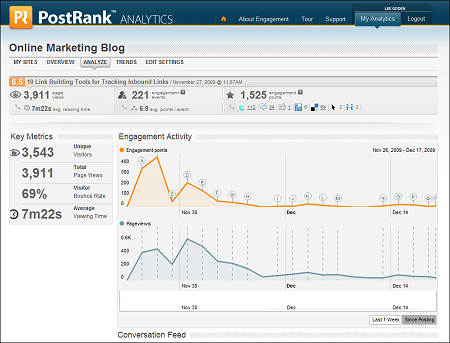
PostRank provides engagement scores to gauge how well pieces of content (i.e., a blog post, a news article) convinced users to take action (i.e., re-Tweet, a blog post comment, an RSS view). But beyond that, this social media monitoring tool shows the messages and comments from other sites that are contributing to the engagement score. In addition to individual pieces of content, this free service also maps out engagement activity and number of page views for entire blogs or websites per day. PostRank also offers integration with Google Analytics. Cost is $9 per month to track 5 sites. The image below illustrates a single post analysis with both engagement metrics and pageviews.
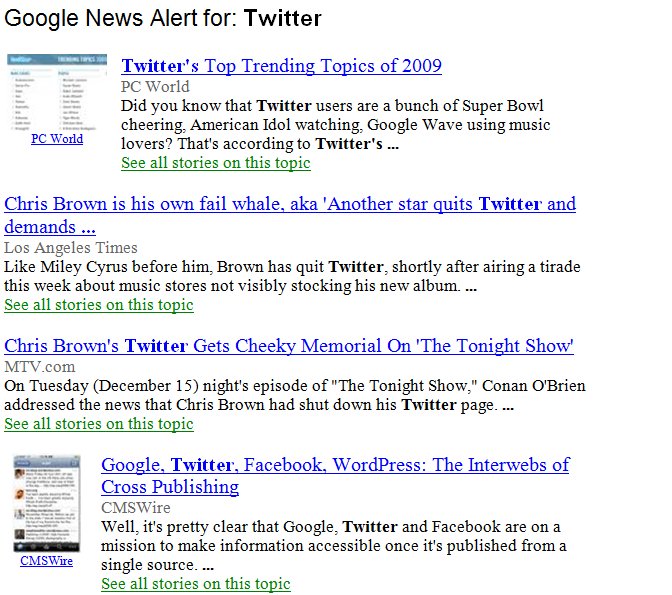
This free tool from Google provides email updates of the latest relevant Google search results. It’s as simple as choosing a search term, determining the type of search results to be tracked (news, blogs, web, video, etc.), selecting update frequency and entering an email address. Google Alerts is one of the easiest ways to monitor brand mentions for both company and product names. Plus, the tool can be leveraged to monitor competitor mentions.
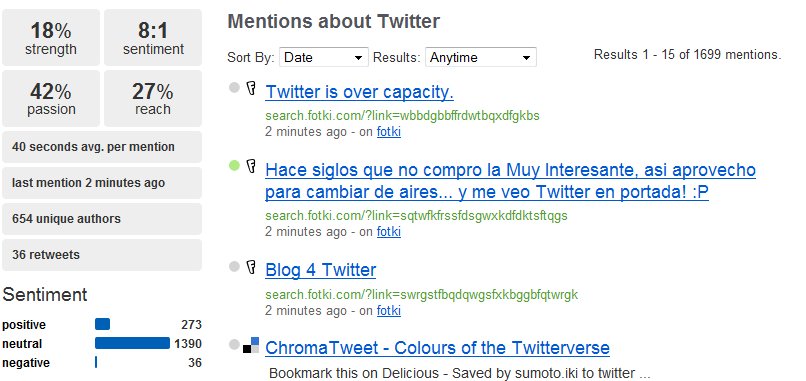
Similar to Google Alerts, Social Mention – a real-time search engine – aggregates search results from blogs, microblogs, videos, bookmarks and other social sites. But this free monitoring tool goes a step beyond that. Social Mention provides a social ranking score based on popularity for every search (i.e., how often the search term is mentioned, if the sentiment is positive/neutral/negative). All of this data can even be compiled into a CVS or Excel spreadsheet.
5. TechrigySM2
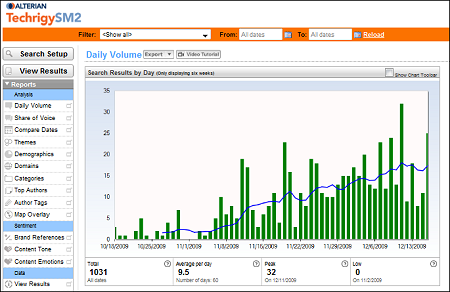
SM2 is a software solution designed specifically for PR and Marketing Agencies to monitor and measure social media. The “freemium” version of this full featured social media monitoring service allows you to create up to 5 profiles and each query is limited to storing up to 1,000 search results. There are many features with setup and reports as you can see in the screen shot below. Along with standard help and FAQ resources, there’s a Ning powered Techrigy social network or Community of users that you can tap into and share information.
Incidentally, we did an interview with Connie Bensen, Director of Social Media and Community Strategy at Alterian, the company that owns TechrigySM2 earlier this month.
Whether you leverage one of these low cost or free tools to get started or other tools like Collective Intellect, Cymphony, Converseon, ScoutLabs or Radian6, it’s critical to track social media efforts and tie results back to the goals of your business. Because the scary truth is this: When cut-backs rear their ugly heads, the first programs to go are those that can’t illustrate measurable results and link them back to organizational goals. Don’t find yourself in that 84% of Mzinga and Babson Executive Education survey respondents who don’t measure the effect of social media.
Ford lleva las aplicaciones del iPhone al volante
Las aplicaciones para celulares inteligentes son las novedad de 2009. Ahora que el año está por llegar a su fin, la compañía automotriz Ford planea cómo llevar este éxito al mercado de los autos para 2010. Según publicó el diario The Wall Street Journal, la firma estaría planeando el lanzamiento de aplicaciones similares a las que se descargan para el iPhone de Apple y en las BlackBerries.Para ello, Ford está tratando de persuadir a los desarrolladores de software para vehículos para que diseñen aplicaciones incorporadas dentro del servicio de Internet, el sistema de GPS y la configuración de música digital que ya se encuentra en su sistema Sync, un producto que la compañía fabricó en conjunto con Microsoft Corporation. Entre las novedades se encontrarían programas para poder recorrer la ciudad y encontrar restaurantes, evitar el tráfico e incluso hacer que varias personas puedan seguir el rastro del conductor, a través de una función que se conoce como “migas de pan”.
Según los analistas, las compañías automotrices están apuntando a personalizar los vehículos que venden para ajustarlos a los gustos y necesidades de cada comprador. Además, como sucede con los celulares y las portátiles, se están sumando a la estrategia para que los usuarios puedan seguir gastando dinero luego de la compra del auto, mejorando las funcionalidades de software que vienen en su interior.
De acuerdo con las especulaciones que se hacen al respecto, otras automotrices se podrían sumar a este proyecto y copiarían el esquema que hoy lleva Apple: podrían obtener ganancias de las aplicaciones, cobrando un porcentaje por cada producto que realizan los desarrolladores como sucede para todas las “apps” que se crean para el iPhone y el iPod.
Por el momento, se prevé que la semana que viene Ford comunique la codificación básica necesaria para desarrollar aplicaciones compatibles con el software de los autos, para comenzar a recibir propuestas de los aficionados a la tecnología. Venkatesh Prasad, encargado de supervisar el desarrollo de Sync, el lanzamiento de este código es el primer paso para hacia el diseño de programas de terceros que puedan interactuar con los autos de Ford a través de teléfonos celulares y otros dispositivos con Internet.
La compañía presentará, a principios de 2010, en la Feria Internacional de Electrónicos, para el Consumo en Las Vegas, nuevas funciones para Sync que se relacionan con la navegación y las comunidades virtuales.
viernes, 18 de diciembre de 2009
La próxima dimensión: programas para el celular
Tras la introducción del 3G en el mercado, a fines de 2007, los teléfonos inteligentes (smartphones) comenzaron a hacerse un lugar entre los consumidores, tanto para tareas corporativas como para el entretenimiento. Medio año más tarde, el mercado se conmocionaba con la llegada del primer iPhone. Hoy, los analistas consideran aquela aterrizaje como el puntapié que le abrió las puertas a la era del Internet móvil en el mercado masivo y a la transferencia de datos. A su vez, el fenomeno impulsó un nuevo segmento de negocios: el de las aplicaciones móviles. El círculo virtuoso se cierra con los fabricantes de teléfonos negociando con las operadoras de telefonía para que brinden más y mejor calidad de transferencia de datos.
Para Bruno Neto, ICT Research Analyst de Frost & Sullivan, “con la evolución de las redes de Internet móvil y aparatos más capacitados, crecen las oportunidades de nuevos servicios y contenidos avanzados para móviles. Estos llegan en un momento en el que el mercado de líneas camina hacia una saturación y los operadores necesitan desarrollar medios para generar nuevos ingresos con nuevos servicios”.
Y agrega, “para el consumidor, la demanda por estos servicios está más concentrada en música, juegos, entretenimiento y redes sociales. Mientras, para el segmento empresarial existen aplicaciones avanzadas, estandarizadas o desarrolladas para tareas específicas, que contribuyen a aumentar la productividad y la competitividad de las empresas”. La demanda ya se refleja en una mayor facturación. Para este año y a nivel mundial, los analistas estiman que el negocio de juegos y programas para el celular generará ingresos por u$s 1.000 millones. En apenas dos años serán u$s 4.000 millones.
A nivel regional, la tendencia todavía se refleja más por el incremento dentro del sector corporativo. Según el estudio “Latin American Mobile Enterprise Services Market”, realizado por la Frost & Sullivan, los ingresos generados por servicios en base a la transferencia de datos registró, en 2008, un incremento de 166 por ciento.
A nivel internacional, el negocio de las aplicaciones promete definir los próximos ganadores en materia de tecnología. Entre los aspectos más interesantes está justamante que en este negocio nada se define por el tamaño sino por la calidad del desarrollo y la demanda que este encuentre. Un caso es el de la estadounidense Zynga. A dos años de su creación, la firma especializada en crear pequeñas aplicaciones de juegos para celulares es rentable, emplea a más de 30 personas y genera ingresos por u$s 100 millones. Para comparar: Google no logró ser rentable hasta pasar el tercer año de vida y aún así facturó menos que Zynga.
Cuestión de desarrollo
Pero, como en todo, las herramientas y aplicativos para celulares, también, vivieron su etapa de ajuste. Desde uno de los proveedores argentinos, Hernán Pentimalli, Mobile Software Gurú de Globant, considera que “la introducción de Internet móvil originó el cambio en la complejidad de las aplicaciones. No funcionaron aquellos concebidos como una adaptación de un software de escritorio, sin tener en cuenta el cambio de paradigma que significa ir a un dispositivo móvil”. Por eso, “nosotros elegimos las cuatro plataformas con más potencial: iPhone, Black Berry, Android y Windows Mobile. Lo hacemos desde hace tres años, cuando realizamos el primer trabajo al crear el cliente web para la red social Funky Sexy Cool (http://fsc.mobi), una experiencia horizontal sobre tres de las plataformas más comunes”, relata.Otra empresa que vio el potencial fue Gloc, empresa argentina especializada en soluciones y programas para dispositivos móviles. Para la Colección de Arte Amalia Lacroze de Fortabat, la firma desarrolló un sistema de AudiovideoWay. Se trata de un sistema de software que corre sobre la plataforma del iPhone o el iPod Touch y le acerca al usuario la historia y contenido de las muestras del museo de la ex dueña de Loma Negra. En conjunto con el personal del museo, la empresa desarrolló los contenidos sobre 30 obras de la colección que incluyen, entre otros, el audio en inglés, portugués y español o un video clip.
Adrián Lebendiker, director de Gloc, cuenta: “Desarrollamos la aplicación de índice en tres idiomas para que corriera bajo el sistema operativo de iPod Touch y le propusimos al museo un modelo de negocios basado inicialmente en la compra de los aparatos con la aplicación y los contenidos ya cargados. El retorno de la inversión se da por la vía del alquiler de los equipos. En ese modelo, la inversión se recuperó durante los primeros seis meses a partir de la inauguración del museo, en octubre de 2008".
Contenidos que venden
El marketing y la publicidad son una de las áreas que más crecen en cuanto a desarrollo de aplicaciones móviles. El gran volumen en tráfico se lo lleva el SMS. Claudio Sasia, gerente de Sistemas de Jet Multimedia Argentina, analiza “todavía corre muy bien el SMS, pero ya trabajamos con desarrollos para una Web móvil ya que por ahí pasa la tendencia, sobre todo porque terminales como los touchscreen con mejor definición e Internet se están expandiendo”.A la hora de desarrollar una campaña de marketing, la compañía se vale para el 60 por ciento y 70 por ciento de los trabajos de plataformas Java. Los trabajos en Flash rondan el 20 por ciento y el 10 por ciento restante se hace en .NET y HTML, entre otros.
Felipe Muñoz, director Comercial de Yahoo! Móvil Latinoamérica, detalla que “para que se genere el impacto en América latina la navegación y las redes deben ser fáciles, rápidas y accesibles en cuanto a costos para el usuario. No cabe duda, en los próximos años el acceso de Internet móvil en celulares superará al de PCs. Por eso, analizamos todas las tecnologías posibles para un mejor aprovechamiento ya sea con el sistema Android (Google) o Windows Mobile”.
El ambiente corp.
A nivel local, los sectores corporativos que más invierten, en soluciones móviles son el de logística, la banca, el financiero, el farmacéutico y las empresas de tecnología, coinciden los entrevistados para esta nota. Se suman mercados como el de la seguridad patrimonial y el turismo.Ignacio Plaza, director de Primary, explica que, para trabajar en los distintos desarrollos para el sector corporativo -entre los que predominan soluciones para el sector financiero- “utilizamos Java porque tiene buena capacidad de penetración, también, algunos aplicativos para Windows Mobile, Symbian, Android e iPhone OS. Pero todavía no hay una plataforma predominante, porque el mercado es naciente y fluctuante”.
Entretenimiento puro
Una de las empresas que amplió su presencia en el mercado fue Gameloft. A partir del crecimiento de Internet móvil y la tecnología touchscreen, la empresa de juegos pudo sofisticar sus ofertas en versiones de alta definición (entre 5 MB y 6 MB, cuando el promedio ronda los 700KB) y 3D. En la Argentina trabajan de manera exclusiva para terminales con Java, Symbian y Windows Mobile. Desarrollar un juego, le lleva entre seis meses hasta un año y pueden llegar a invertir cerca de 500.000 euros en un sólo juego.Paula Haurie, Key Account Manager Cono Sur de Gameloft, afirma ante IT Business que “las plataformas, los sistemas operativos y la capacidad de memoria evolucionan día a día junto al hardware (en cuanto a display y pantalla). Permiten así un campo de contenidos móviles más rico y complejo de calidad: ofrecer valores agregados basados en Java como la función de sensor de movimiento, juegos para terminales touch, catálogos en High Definition (HD), que permite conectar la terminal al plasma. Para los de HD es necesario contar con celulares con Wi-Fi o 3G, ya que se descargen de portales”.
Introducirse al negocio móvil requiere dedicación. Un ejemplo es la experiencia de la red social Sonico. Empezaron a trabajar en su versión para celulares en paralelo a la para PC, pero el primer portal WAP lo hicieron con principios y conceptos de Internet. Tomás O´Farrell, Partner & Chief Marketing Officer de la empresa, señala: “fue un fracaso porque la actividad del usuario es diferente en su uso”. Pero, al poco tiempo, hicieron las modificaciones necesarias en la segunda versión y ya van por la tercera. Hoy, la red social para celulares está basada en Java y el sitio, en PHP.
“Pero no todo el contenido está volcado. Por ejemplo, no está presente la invitación de amigos ya que prima la interacción. El video es otro de los aplicativos que tardará en llegar porque los parámetros de los sistemas entre terminales y las redes está fragmentados”, comenta el referente.
Un nuevo paradigma
La base para crecer en este tipo de negocios también en la Argentina está ligado al acceso a la Internet móvil y al servicio que llega -por ahora- desde los tres operadores locales Personal, Claro, Movistar. Según fuentes de Personal, el 80 por ciento de sus clientes utilizan Internet móvil 3G a través de dispositivos celulares. El 20 por ciento restante lo hace mediante módem 3G. Entre los principales usos destacan el chequeo del mail (80 por ciento), navegación web (78 por ciento), chat (más del 60 por ciento) y lectura de diarios y noticias (57 por ciento). Más del 90 por ciento de ellos utilizan el servicio por temas personales y el 60% por ciento por motivos laborales.Desde la filial de Telecom, señalan que la demanda en el tráfico de datos que tuvieron de las redes creció en más de diez veces durante el primer trimestre de 2009, en relación al año anterior. Incluso proyectan un parque 3G de más de 1 millón de clientes antes de fin de año. Para lograrlo -según fuentes de la empresa- invertirían $ 800 millones en el desarrollo de la red y así garantizarán capacidad y cobertura para soportar la evolución de la banda ancha móvil local. Cuentan con una infraestructura 3G desarrollada bajo la norma HSDPA/UPA que alcanza, en las principales ciudades, picos de velocidad de descarga de hasta 7,2 MB.
Por su parte, Claro está presente en 300 ciudades del país y brinda servicios de Internet móvil 3G: con abono fijo de 200MB de navegación y mail (desde $49, plan Zero). “Las ventas de Internet móvil crecieron en el último año un 100% en volúmenes de nuevos clientes. Hay un incremento mensual de 40.000, entre los usuarios de Internet a través de dispositivos celulares como también de módems para la Internet móvil. Creemos que este servicio va a ser un producto de consumo masivo que continuará creciendo”, comenta Fernando del Rio, director Comercial de la compañía.
La visión del operador
Con aproximadamente el mismo alcance nacional, Movistar relevó en el mes de junio 80.000 teléfonos 3G y 150.000 placas de Web móvil. En cuanto a la inversión en nuevas tecnologías para este año, la empresa destina más de $700 millones, de los cuales una parte será destinada a la ampliación de su red de tercera generación y en nuevos servicios.Christian Magnalardo, gerente de Datos Móviles de Movistar, cuenta que “el mercado ha tenido un importante crecimiento desde el lanzamiento de las redes de tercera generación, tanto en cantidad de clientes, como en el desarrollo de servicios. Si tenemos en cuenta que de banda ancha fija hay tres millones de hogares, podemos decir que el servicio ha captado un 10% del mercado de banda ancha. Estimamos, para fines de 2009, alcanzar los 300.000 clientes de Internet móvil”.
Entonces, ¿qué faltaría para que se masifique? Según Magnalardo, “en la medida que baje la barrera de entrada a estos dispositivos, la penetración de la banda ancha móvil irá mejorando. Desde Movistar, hemos trabajado este año con el foco en tres ejes: altas de equipos inteligentes, oferta comercial de planes y servicios, y degustación de datos”. La empresa cuenta con una promoción hasta fin de año de “degustación” de 100MB para navegar en Internet, chequear mails y chatear.
El futuro
En 2010, la Unión Europea destinaría 18 millones de euros para la investigación en redes móviles de 4G. Uno de los motivos es la consolidación de la tecnología wireless Long Term Evolution (LTE) para permitir que la Internet móvil alcance hasta 100 megabits por segundo, o sea, diez veces más que la red 3G.Mientras en la Argentina, Pentimalli, de Globant, considera que: “La tendencia será incorporar streaming de audio y video de alta resolución, generar interfaces de usuario más completas y de un alto nivel de usabilidad e incluir elementos de interface con el usuario y el mundo exterior como acelerómetros, sistemas de posicionamiento, reconocedores de voz, faciales y gestuales que hacen que los dispositivos alcancen un nuevo nivel de integración”.
Por su parte, Neto, de Frost & Sullivan explica que “los contenidos para celulares van seguir desarrollándose con nuevos aplicativos más customizados para atender a variados tipos de perfiles de clientes. La emergencia de nuevas empresas desarrolladoras impulsará la competencia por contenidos creativos, que sean convergentes, que generen tráfico de datos e ingresos para los operadores, mientras ofrecen mayor entretenimiento para el usuario”. Por otra parte, destaca la necesidad de “mas herramientas para el profesional, que estará cada vez mas conectado”. El catalizador: la caída de los precios de banda ancha móvil y mayor oferta de smartphones.
Para Claudio Ochoa, ingeniero de software Senior en el Centro de Desarrollo de Software de Intel en Córdoba: “las terminales todavía necesitan tener instrucciones de procesador. Por ello, estamos adaptando Intel Atom para que esté en celulares, pero será recién en 2010 con un dispositivo de LG que se podrá apreciar la experiencia”. Sin duda, quien piense en el recambio de su celular ya tiene que pensarlo como su próxima computadora de mano.
